

Anterior Approach Hip Replacement
Total hip replacement surgery is regarded as one of the most successful surgeries in the history of medicine. The procedure relieves pain and restores mobility to people whose hip joints have been damaged by trauma or degenerative “wear-and-tear“ arthritis. This article discusses a particular method for total hip replacement called the “direct anterior” or simply “anterior approach.“

Types of surgical approaches
The Hospital for Special Surgery (HSS) in New York City has been ranked the #1 orthopedic hospital in the United States for 16 consecutive years and performs more hip and knee replacement surgeries than any other hospital in the United States, making it one of the highest-volume joint replacement centers in the world. Our surgeons and researchers continually work to improve the success of joint replacement surgery by developing, evaluating and refining surgical procedures and processes. Orthopedic surgeons have a range of options to gain access to the hip joint during surgery. These options are known as surgical approaches. During the surgery, the hip joint can be accessed through several approaches including:
- the back of the hip – the “posterior” or “STAR” approach
- the front of the leg – “direct anterior” or “anterior” approach
The fact that there are multiple approaches to perform a hip replacement means that there is no “best” surgical approach. Each approach has advantages and disadvantages. The surgical approach is chosen carefully by your surgeon based on a number of factors, including but not limited to your anatomy, body type, medical history, the complexity of the procedure, surgeon and patient preference.
The anterior and posterior approaches are both commonly used at HSS. HSS surgeons are careful not to treat any single surgical approach as appropriate for every patient. Both approaches have their place and choosing the appropriate surgery is a shared decision-making process between the surgeon and the patient, treating each patient as an individual.
“Posterior” or “STAR” hip replacement
The posterior approach was the most popular surgical approach for many decades. It involves accessing the hip joint through an incision made on the side of your hip. This approach provides doctors with an excellent view of the hip structures, allowing for optimum placement of all kinds of hip implants.
Over the years, doctors have refined this procedure so that it is less invasive to the soft tissues while still maintaining safety and effectiveness. This minimally invasive hip replacement technique – pioneered at HSS – has helped to diminish muscle trauma and reduce length of hospital stay. This is known as the superior transverse anatomic reconstruction (or STAR) approach.
“Direct anterior” or “anterior” hip replacement
The direct anterior approach to hip replacement has been used since the early inception of hip replacement and it has gained popularity in recent years. It is now equivalent to or exceeds the number of posterior approaches performed across the United States.
The incision is made in the front of the thigh, rather than on the side (as in the posterior approach).
Who can have an anterior hip replacement?
A discussion with your surgeon should help you decide when anterior hip replacement is appropriate for you. The decision is made on an individual basis, treating each patient according to their needs.
Animation: Anterior hip replacement approach
What are the advantages of anterior hip replacement?
The anterior approach to the hip makes it possible to reach the hip joint by entering planes between muscles, and minimizes muscle splitting and tendon releases. In the appropriately selected patient, hip replacement performed using the anterior approach may be associated with earlier improvement in functional recovery, especially in the first 2 to 4 weeks, in comparison to the posterior approach. Afterwards, there may be no significant recovery differences between the anterior and posterior approaches.
The reoperation rates (the possibility of requiring a revision surgery) for both approaches are similar. The incidence of a hip dislocation in some patients may be higher in the posterior approach.
Deep infection rates are similar for both approaches.
What are the disadvantages and risks of anterior hip replacement?
Risks of the anterior approach are similar to those in the posterior approach. The major risks of hip replacement surgery are infection, dislocation, blood clots, leg-length discrepancy, nerve or blood vessel injury, complications from anesthesia and medical complications.
Is hip replacement painful?
All surgery has some pain associated with it but, fortunately, hip replacement surgery through both the anterior and posterior approaches tend to be less painful than in the past because of pain management techniques developed by HSS surgeons, anesthesiologists and researchers.
What is the recovery time for anterior hip replacement?
Most patients are walking with a cane the day of surgery or by the next day. This allows rapid progress and more independence for the patient − often allowing most patients to go home on the day of surgery or the next morning. Cane use is generally two to three weeks and activities progress accordingly with return to active sport by three months.
Physical therapy may be done in person or remotely, but in many cases formal physical therapy is not needed at all. By about the three-month mark, anterior and posterior approach patients are functioning equally well and the long-term results and longevity are similar.
A 2026 HSS study found that patients who prefer the anterior approach often expect a faster, less painful recovery than patients without this preference. But current evidence shows that pain relief and recovery speed tend to even out between approaches within the first few months. Long-term outcomes are excellent with either approach when performed by an experienced surgeon.
How successful are anterior hip replacements?
It is important to note that the results of total hip arthroplasty are outstanding in terms of relief of pain and improvement in function. There has been, to date, no clinical study demonstrating the superiority of one surgical approach over another. The possible short-term benefits of one surgical approach over another must always be balanced with the possible untoward side effects unique to that approach.
Anterior hip precautions
Recently, improvements in surgical technique, instrumentation, and patient selection have made anterior hip replacement a viable option for most patients considering total hip replacement. Most patients do not need so-called “hip precautions” or significant restrictions in how one can move after hip replacement.
Currently, if performed by an experienced surgeon, an anterior hip replacement can result in rapid recovery after surgery. However, it is important to realize that one still needs adequate time to recover after surgery and recovery time depends on the level of function before the surgery and what activities are desired after surgery. The selection of the appropriate patient for anterior arthroplasty is crucial to the overall success of the surgery and your surgeon will discuss which surgical approach is best for your individual condition.
What is the role of enabling technology in anterior hip replacements?
Enabling technologies for anterior hip replacement include fluoroscopy and computer assistance with surgical navigation or robotics. These tools provide the surgeon with real-time information to help optimize implant positioning during surgery. Because the direct anterior approach is performed with the patient lying on their back (supine), it is particularly well suited to the use of these technologies, especially intraoperative fluoroscopy.
To date, there is no consistent evidence showing superiority of technology assisted anterior hip replacement compared with well-performed conventional anterior hip replacement. It is recommended to talk with your surgeon regarding the techniques they are most comfortable with and best suit your individual needs.
Why should you choose HSS for hip replacement?
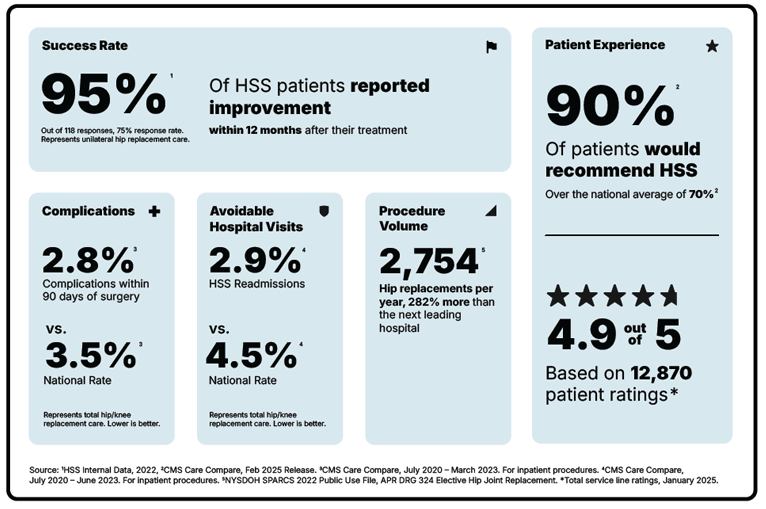
Hip replacement is a surgery focused on reducing pain and getting you back to the activities you love. But not all hospitals achieve the same results. Some are more reliable than others. With the help of the HSS Hospital Reliability Scorecard, you can make sure you're asking the critical questions to find the hospital that's right for you. Understanding these data points will help you make the best decision for your care: See hospital reliability data
Authors


Explore Related Patient Stories
View All Patient Stories
John Fernandes
Setauket- East Setauket, NY
Hip Replacement Surgery

Kennesy Moore
Queens, NY
Hip Replacement Surgery

Katherine Mitchell
Sag Harbor, NY
Hip Replacement Surgery

Susan Friedman
Wellington, FL
Hip Replacement Surgery

Peter Rothwell
Harrington Park, NJ
Hip Replacement Surgery

Nina Gordon
Great Neck, NY
Spinal Stenosis

David Feldbaum
Bronx, NY
Hip Replacement Surgery

Lynne Calman
New York, NY
Scoliosis

Analisa Barrett
Brooklyn, NY
Hip Replacement Surgery
Gail Morton
Highland Lakes, NJ
Hip Replacement Surgery

R. D.
Brooklyn, NY
Hip Replacement Surgery

Diana Abreu
Long Valley, NJ
Hip Replacement Surgery
Justin Blasich
Stewart Manor, NY
Hip Replacement Surgery

Mauro Bruni
New York, NY
Hip Replacement Surgery

Arleen Mitchell
New York, NY
Hip Replacement Surgery

Elizabeth Andrews
Brooklyn, NY
Hip Replacement Surgery

Gary Divito
St. Augustine, FL
Hip Replacement Surgery
Kathy Friedman
New York, NY
Hip Replacement Surgery
Christina Galanti
Hewlett, NY
Hip Replacement Surgery

Melanie Grisanti
New York, NY
Hip Replacement Surgery
References
- Boettner F. Not a One-Size-Fits-All Approach for Total Hip Arthroplasty?: Commentary on an article by Jacob M. Wilson, MD, et al.: "Outcomes After Direct Anterior Approach Total Hip Arthroplasty. A Contemporary Multicenter Study". J Bone Joint Surg Am. 2025 Feb 19;107(4):e12. doi: 10.2106/JBJS.24.01070. Epub 2025 Feb 19. PMID: 39969497. https://pubmed.ncbi.nlm.nih.gov/39969497/
- Borazjani R, DeMoes D, Jones T, Burgio C, Gualtieri A, Vigdorchik J, Kreuzer S. Agreement of imageless navigation-derived pelvic tilt measurements with radiographic and CT-based measurements in direct anterior total hip arthroplasty: A prospective single-center study. J Exp Orthop. 2026 Jul 7;13(3):e70842. doi: 10.1002/jeo2.70842. PMID: 42415944; PMCID: PMC13340135. https://pubmed.ncbi.nlm.nih.gov/42415944/
- Coxe FR, Deeb AT, Bhatti P, Alschuler DM, Della Valle AG, Blevins JL, Mancuso CA, Long WJ, Gausden EB. Prospective Assessment of Expectations of Recovery Following Total Hip Arthroplasty: Patients Expect Less Pain With the Direct Anterior Approach. J Arthroplasty. 2026 Apr 17:S0883-5403(26)00371-2. doi: 10.1016/j.arth.2026.04.035. Epub ahead of print. PMID: 42001908. https://pubmed.ncbi.nlm.nih.gov/42001908/
- Subramanian T, Oles A, Halayqeh S, Mazzucco M, Jolissaint J, Mallett K, Debbi EM, Gausden EB. Systematic Review of Wound Complications After Direct Anterior Approach Total Hip Arthroplasty: Incidence, Risk Factors, and Management Strategies. J Am Acad Orthop Surg. 2026 Jun 1. doi: 10.5435/JAAOS-D-25-01035. Epub ahead of print. PMID: 42224471. https://pubmed.ncbi.nlm.nih.gov/42224471/