

Nonunion Fracture: (When a Broken Bone Doesn't Heal)
Summary: This article provides an overview of nonunion fractures, which are fractured bones that fail to heal. It reviews symptoms, risk factors, and why some fractures are more difficult to heal. Readers will learn about nonsurgical and surgical treatments, recovery expectations, and how maintaining healthy habits can support the healing of bone fractures.
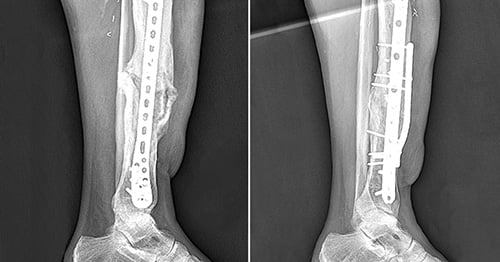
What is nonunion fracture?
A nonunion fracture (which physicians more commonly call a “fracture nonunion” and is sometimes also referred to as a “nonhealing fracture”) occurs when pieces of a broken bone (fractured bone) do not heal solidly together.
After a fracture occurs, the body starts to heal the bone. The healing process, with or without surgery to repair the broken bone, typically takes 6 to 12 weeks. During this time, the body makes new bone to fill-in any spaces or gaps between the edges of the fractured bone pieces. This is similar to how a tree branch mends if it becomes cracked or bent. When a bone is “healed,” it is considered “united” back together.
There are times when the body cannot fully mend the fractured bone pieces back together to form a single solid piece of bone. This is called a nonunion: The bone has not “united” together. In a nonunion situation, X-rays at different points in time will typically show no progression of the fracture healing process. Generally speaking, nonunions are not likely to heal without further medical intervention because the body’s healing process has “petered out.”
In the situation of a nonunion, additional treatments are needed to stimulate the body to resume the healing process. These treatments usually entail surgical nonunion repair, but sometimes nonsurgical methods such as the use of bone stimulators can be effective at getting nonunions to fully heal.
What is the difference between nonunion, delayed union, and malunion of a fracture?
A nonunion is when a fractured bone does not heal solidly back together and X-rays show no progression towards healing. With nonunions, there is little chance the bone will fully heal with additional time. A delayed union means that the bone is healing more slowly than is typical, but the fracture shows progressive signs of healing. Delayed unions have the potential to heal without additional interventions. Malunion is when the bone has healed crooked.
How common are nonunions?
Bone fracture nonunions are not common, but they are not rare either.
What are signs a broken bone isn’t healing?
Clinical signs of nonunion are most commonly pain at the fracture site which is made worse by physical stress on the fractured bone (such as walking on a fractured leg bone). The severity of nonunion pain depends much on how the original fracture was treated. Sometimes, surgically stabilized fractures that go on to develop a nonunion produce very little pain, which can make them detectable primarily through radiological imaging. At other times, especially when there was no surgery to stabilize the bone, a nonunion can be very painful and debilitating.
Why do some bone fractures heal more slowly than others?
Different fractures have different risks for nonunion based on several factors, such as which bone is broken, what portion of the bone was broken, how severe the fracture was, and the general health of the person with the fracture. These same factors also impact the speed at which fractures heal. In general, adults, regardless of age, heal at similar rates. Children, especially those still growing, generally heal faster than adults.
Why do some broken bones fail to heal and develop a nonunion?
The more severe a fracture is, the higher the risk of nonunion. More severe fractures are those that result from higher energy impacts. For example, fractures that occur from a high-speed motor vehicle or motorcycle accident are considered “high energy,” are high severity, and have higher risk of nonunion than “lower energy” fractures such as a broken ankle from a twisting injury. Also, fractures that develop an infection often fail to heal.
There are certain medical conditions, medications, and habits that can slow fracture healing and potentially lead to nonunion. For example, diabetes, oral steroid medications, and smoking are all well known risk factors for developing a nonunion after a fracture.
Are some bones more prone to nonunion than others?
Although any bone can develop a nonunion, some bones are more prone than others. For example, the tibia bone (shin bone) and the scaphoid bone in the wrist have higher risks for nonunion than most other bones. This is mainly because these bones have less robust blood supply (circulation) than other bones. All tissues in the body require good circulation for healing. When blood supply is compromised, so is healing.
Can you walk on a nonunion fracture of the leg?
Walking on a leg nonunion is a very different situation from walking on a fresh fracture. In the situation of a fresh fracture, walking is typically not recommended because it may compromise good fracture healing and it would be very painful. With a nonunion, which is many months after the fracture originally occurred, the situation is very different. Often, pain is the primary limitation for walking on a nonunion. If it is not too painful, then walking on a nonunion may be recommended to help rehabilitate leg muscles. However, the safety of walking on a nonunion depends on many factors and an orthopedic surgeon with extensive experience treating nonunions should be consulted.
Are there different types of fracture nonunions?
Nonunions are generally classified in two ways based on:
- Whether there is an associated infection or not
- How much bone healing the body was able to produce.
An infected nonunion (also sometimes called a “septic nonunion”) is when there is an infection in the bone at the site of the fracture nonunion. An “aseptic nonunion” is when there is no infection at the nonunion site
The most common risk factor for an infected nonunion is when the original fracture pierced through the skin. These fractures are called compound fractures or “open fractures.” The bone in such cases is exposed to the “open air” and outside elements. The exposed bone can become contaminated with bacteria from the skin itself (all skin normally has bacteria in it) or any dirt that the bone may have come into contact with. Infection inhibits the healing process and can cause additional pain.
Septic nonunion: A complex condition that requires a complex care team
A septic nonunion refers to a nonhealing fracture complicated by an infection at the fracture site. Normally, the first priority in treating infected nonunions is to manage the associated infection. Once infection is controlled or eradicated, priority shifts to getting the nonunion to heal. Occasionally, both infection treatment and nonunion treatment can occur simultaneously. Infected nonunions are among the most difficult to treat.
At HSS, we have an experienced multidisciplinary team to manage the individual needs of each unique infected nonunion situation.
Our nonunion and bone healing team includes orthopedic surgeons who specialize in these complex problems. HSS infection disease specialists provide expert tailoring of antibiotic treatments, musculoskeletal radiologists provide state-of-the art imaging modalities such as CT, MRI, and bone scans, and metabolic bone specialists can treat underlying bone healing deficiencies and osteoporosis with targeted medications.
Patient case: Treating a complex, infected nonunion of the tibia
A healthy 67-year-old man sustained a compound fracture of his left tibia and fibula in a dirt-bike accident. Initial treatment at another hospital included cleaning of the wound, stabilization of the tibia with internal fixation, and graft of healthy muscle tissue from another section of his leg to cover and improve blood supply to the injured area and protect it from infection.
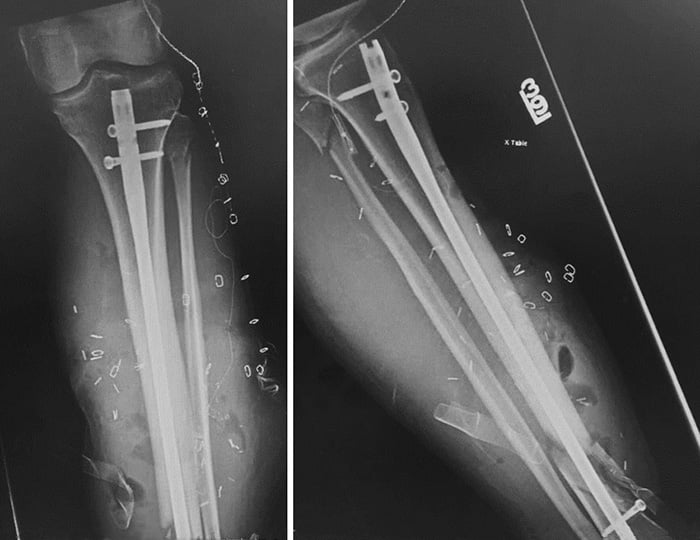
X-rays of two views of the tibia after the patient’s original surgery. They show intramedullary nail fixation of his open (compound) fracture, and multiple surgical clips in place associated with the anterolateral thigh free muscle flap.
The fracture subsequently became infected and failed to heal despite multiple procedures, soft-tissue reconstruction, nonunion repair and prolonged antibiotic treatment.
The patient then came to HSS and was evaluated for further treatment. Imaging showed there was a persistent (or “recalcitrant”) tibial nonunion with areas of nonviable bone. The tibia had also healed into a varus alignment, meaning the lower leg angled inward toward the other leg rather than straight.
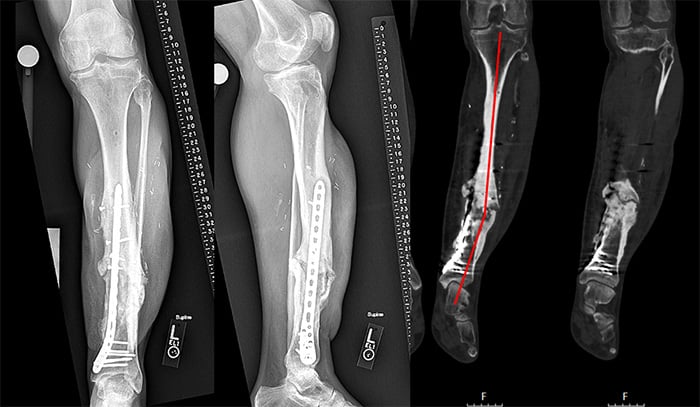
Preoperative X-rays and CT images show the persistent tibial nonunion, an inward-angled deformity, and areas where bone tissue has lost its blood supply, resulting in the death of its cellular components (osteocytes).
HSS surgeons executed a complex reconstruction intended to remove unhealthy bone, correct the alignment of the leg, provide stable fixation, and create conditions in which the tibia could heal. The man then had six weeks of intravenous ceftriaxone (a broad-spectrum antibiotic used to treat and prevent infections).
At the three-month follow-up visit, the man’s surgical wound had healed, he was taking oral amoxicillin as prescribed, and he was walking with full weight on the leg without an assistive device or any pain medication. In time, the man was able to return to demanding physical activity, including riding and jumping horses.
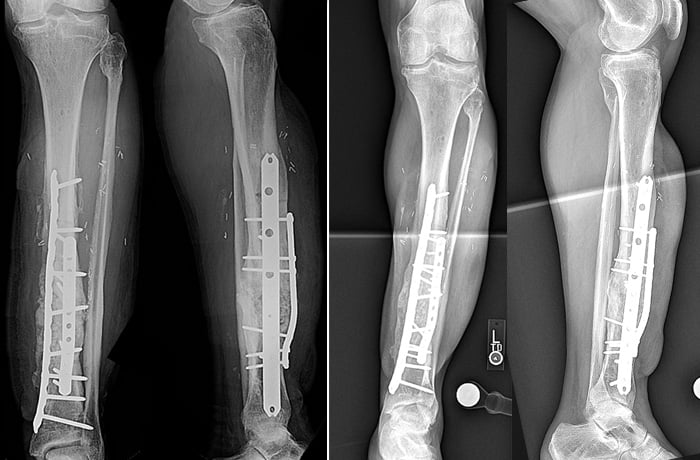
Left: X-rays at three-month postsurgical follow-up visit showing extensive plate-and-screw fixation spanning the affected portion of the tibia, and healed fracture. Right: X-rays at 21 months after surgery.
How does a doctor diagnose a nonunion?
Most often, X-rays are the primary method to detect a nonunion. Other imaging tests such as CT, and occasionally MRI, can be helpful in making the diagnosis of a nonunion.
Can you live with a nonunion fracture?
Nonunions can be painful and functionally debilitating but they are not life threatening. Many patients live with nonunions for months or even years. The timing of treatments, especially surgery, is best when the patient is physically and mentally ready.
Does a nonunion fracture always require surgery?
Surgery is not always required to treat nonunions. There are times when nonsurgical methods are the preferred initial treatment recommendation. There are other times when surgery is clearly the most reliable treatment. It is important to seek an orthopedic surgeon with extensive experience with nonunions to help determine the best treatment course for your individual situation.
At HSS, we stress that treatment of nonunions is individualized to each patient.
Can a bone stimulator treat a nonunion?
The proven benefit for bone stimulators in the treatment of nonunions is unclear. On the other hand, there is no substantial evidence that bone stimulators cause harm to bone healing. The process by which bone stimulators work is slow. The patient must be willing to invest approximately three months using a bone stimulator. Also, there are some nonunion situations where a bone stimulator can reasonably be considered as a treatment option and some others when it should not.
In a general sense, two things are needed for successful bone fracture healing: mechanical stability (such as casts or surgically inserted orthopedic hardware) and biologic stimulus. When a nonunion has good mechanical stabilization and just needs more biologic stimulation, a bone stimulator may be reasonable to consider. When the mechanical environment is unsound, a bone stimulator is not likely to work. An experienced nonunion surgeon can help determine if a bone stimulator is reasonable for your particular situation.
What is the surgery for nonunion?
In all aspects of medicine, it is important to have a clear diagnosis before the best treatment can be determined. Once your nonunion is evaluated by our team, the type of nonunion is determined, and any unique circumstances considered, surgical strategies can then be developed specific to your situation.
In a general sense, successful nonunion surgery provides mechanical stability to the fractured bone with orthopedic hardware, provides a biologic stimulus to “jump-start” healing of the bone, and addresses any alignment issues (straightens out any crookedness). The specific hardware used depends greatly upon which bone was broken, where in the bone the original fracture was, any prior treatments, and the condition of the skin and muscle in the vicinity of the nonunion. An experienced nonunion surgeon will take these and other factors into consideration when determining the customized surgical plan for your nonunion.
What is the recovery time for nonunion surgery?
Recovery after treatment for a nonunion must consider bone healing as well as muscle healing and rehabilitation. Bones typically take 6 to 12 weeks to heal solidly although healing bone gets stronger and stronger for up to about a year. Depending upon the treatment used, weight-bearing activities may start immediately after surgery or may be delayed for several weeks. Therapy to restore range of motion, muscle strength, endurance, and balance typically continues for weeks or months after bone healing.
Will the surgical hardware for a nonunion remain in place forever or does it need to come out?
In most cases, orthopedic hardware used to treat nonunions can safely be left in place and does not need to be surgically removed. However, in situations where the hardware causes discomfort (physically or mentally), it can usually be safely removed after the nonunion is maximally healed. In general, hardware used for nonunion surgery should be left in place for at least nine months. After that time, it can be (but does not need to be) removed at any point in time, even years after surgery.
How can you prevent a fracture nonunion?
Although there is no reliable method to avoid a nonunion, there are several things that a patient can do to maximize the ability to heal a fracture, including quitting smoking and maintaining good nutrition.
Quit smoking if you are recovering from a fracture
Smoking has been scientifically linked to the development of fracture nonunions. Among other things, it is thought that nicotine causes constriction of microscopic blood vessels leading to reduced blood flow to the fracture. As we discussed above, reduced blood flow can reduce the healing of fractures.
We understand that quitting smoking is extremely difficult. We encourage all patients with new fractures or with established nonunions to do their best to quit or at the very least substantially reduce their smoking. At HSS, we also have support for this difficult journey.
Diabetics should keep their blood sugar under tight control
Diabetes, especially if poorly controlled, can slow fracture healing. Good control of blood sugar is an important step to maximize the body’s ability to heal fractures.
Maintain good nutrition
All tissues in the body require good nutrition to be healthy and to heal when injured. Bone is no different. A good balanced diet including protein and essential vitamins is encouraged. If you have a history of thyroid problems or Vitamin deficiency, especially Vitamin D, you should make your physicians aware of this. Proper thyroid function and Vitamin levels are important for fracture healing.
Key takeaways
- A fracture nonunion occurs when broken bone pieces fail to heal solidly together and follow-up X-rays show no healing progression. Unlike a delayed union, a nonunion is unlikely to heal with additional time alone.
- Severe, high-energy fractures, infection, poor blood supply, diabetes, oral steroid use and smoking can increase nonunion risk. The tibia and scaphoid are especially vulnerable because their circulation is less robust.
- Persistent pain at the fracture site, especially during weight-bearing or other physical stress, is the most common symptom. Some surgically stabilized nonunions cause little pain and are detected mainly through imaging.
- Nonunions may be infected or uninfected. Open fractures carry greater infection risk because exposed bone can encounter bacteria. Infected nonunions require infection control and often coordinated care before or alongside bone-healing treatment.
- Treatment is individualized, and surgery is not always required. Bone stimulators may be considered when the fracture already has adequate mechanical stability, but they are unlikely to work when stabilization is poor.
- Nonunion surgery aims to restore stability, stimulate bone healing and correct alignment. The specific hardware and surgical plan depend on the affected bone, fracture location, prior treatments, infection status, and surrounding skin and muscle.
- Recovery must address both bone healing and rehabilitation. Bone generally takes 6 to 12 weeks to unite, while therapy to restore motion, strength, endurance and balance may continue for weeks or months afterward.
Authors

References
- Ricci WM, Ollivere BJ. Principles of nonunion and bone defect treatment. In: Tornetta III P, Ricci WM, Ostrum RF, McKee MD, Ollivere BJ, de Ridder VA, eds. Rockwood and Green's Fractures in Adults. 10th ed. Wolters Kluwer; 2025:873-925. [1, 2, 3, 4].
- Barth KA, Bilodeau RE, Haeberle HS, Megerian MF, Klinger CE, Schimizzi GV, Ricci WM. Septic Long Bone Nonunion Repair Outcomes Are Associated with Culture Organisms. J Orthop Trauma. 2025 Oct 24. doi: 10.1097/BOT.0000000000003110. Epub ahead of print. PMID: 41134188. https://pubmed.ncbi.nlm.nih.gov/41134188/
- Baldwin P, Li DJ, Auston DA, Mir HS, Yoon RS, Koval KJ. Autograft, Allograft, and Bone Graft Substitutes: Clinical Evidence and Indications for Use in the Setting of Orthopaedic Trauma Surgery. J Orthop Trauma. 2019 Apr;33(4):203-213. doi: 10.1097/BOT.0000000000001420. PMID: 30633080. https://pubmed.ncbi.nlm.nih.gov/30633080/
- Borrelli J Jr, Prickett WD, Ricci WM. Treatment of nonunions and osseous defects with bone graft and calcium sulfate. Clin Orthop Relat Res. 2003 Jun;(411):245-54. doi: 10.1097/01.blo.0000069893.31220.6f. PMID: 12782881. https://pubmed.ncbi.nlm.nih.gov/12782881/
- Bellabarba C, Ricci WM, Bolhofner BR. Results of indirect reduction and plating of femoral shaft nonunions after intramedullary nailing. J Orthop Trauma. 2001 May;15(4):254-63. doi: 10.1097/00005131-200105000-00004. PMID: 11371790. https://pubmed.ncbi.nlm.nih.gov/11371790/
- Leduc S, Ricci WM. Treatment of infection after fracture fixation. Opinion: two-stage protocol: treatment of nonunion after treatment of infection. J Orthop Trauma. 2007 Aug;21(7):505-6. doi: 10.1097/01.bot.0000247080.48042.47. PMID: 17762488. https://pubmed.ncbi.nlm.nih.gov/17762488/
- Ernst A, Wilson JM, Ahn J, Shapiro M, Schenker ML. Malnutrition and the Orthopaedic Trauma Patient: A Systematic Review of the Literature. J Orthop Trauma. 2018 Oct;32(10):491-499. doi: 10.1097/BOT.0000000000001254. PMID: 30247276. https://pubmed.ncbi.nlm.nih.gov/30247276/