

Patient Story of: Miriam Fein
Plainview, NY
Ankle Replacement (Ankle Arthroplasty)
Many people told me to give up. My doctors simply helped me heal, so I could get back to the place I wanted to be.
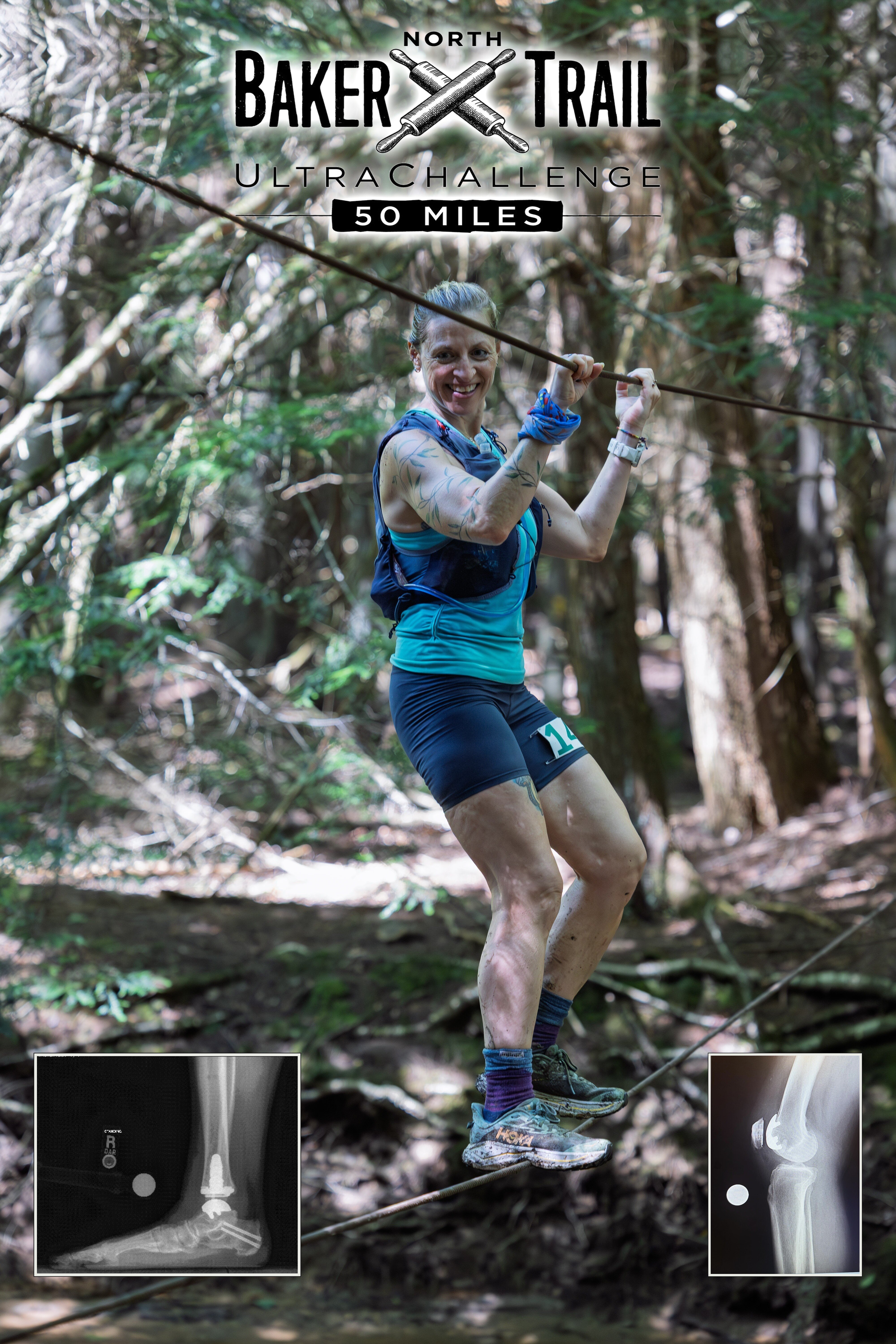
Exactly one year after a total ankle replacement – and eight months after a partial knee replacement – I completed the first 50-mile race I had run in four years. I finally felt like myself again.
I have been a long-distance trail runner for many years, covering distances up to 100 miles at a time. It was not just something I loved. It gave me peace and stability, and it was part of my identity. I spent hours in the woods, alone or with friends, in the heat of summer and in snowstorms.
So when my osteoarthritis worsened to the point that running became impossible, I turned to HSS.
By the time I saw Scott A. Rodeo, MD, I had already had arthroscopic surgery on my right knee after years of running with pain. I came to him with a large full-thickness osteochondral defect – an area of missing cartilage and underlying bone – on the inner side of the knee. Dr. Rodeo performed an OATS procedure (osteochondral autograft transfer), transplanting cartilage plugs into the damaged area.
Over the next 18 months, though, the widespread arthritis behind my kneecap continued to worsen. Fortunately, the inner and outer parts of my knee were still in good shape, so I was able to have a partial knee replacement – a patellofemoral replacement – instead of a full one. I hope to delay a total knee replacement for as long as possible.
During roughly the same period, I was also dealing with severe ankle arthritis. I came to HSS with two previous surgeries on my right ankle. I tried an ankle distraction procedure, which temporarily separates the joint surfaces, hoping to delay an ankle replacement. That surgery was unsuccessful, and I developed septic arthritis, which caused further damage to the joint.
I met with Constantine A. Demetracopoulos, MD, about six months after the failed procedure, and I told him upfront that I wanted to run again. I had no complications with the ankle replacement. Afterward I worked tirelessly, going to physical therapy twice a week and receiving shock-wave therapy on my tendons for months.
My goal was a race I had run 10 times before: the Baker Trail UltraChallenge, a rugged 50-mile course in western Pennsylvania. It is held at the end of August, which would fall exactly one year after my ankle replacement and eight months after my knee replacement. I knew it would be a difficult goal, but I wanted to try.
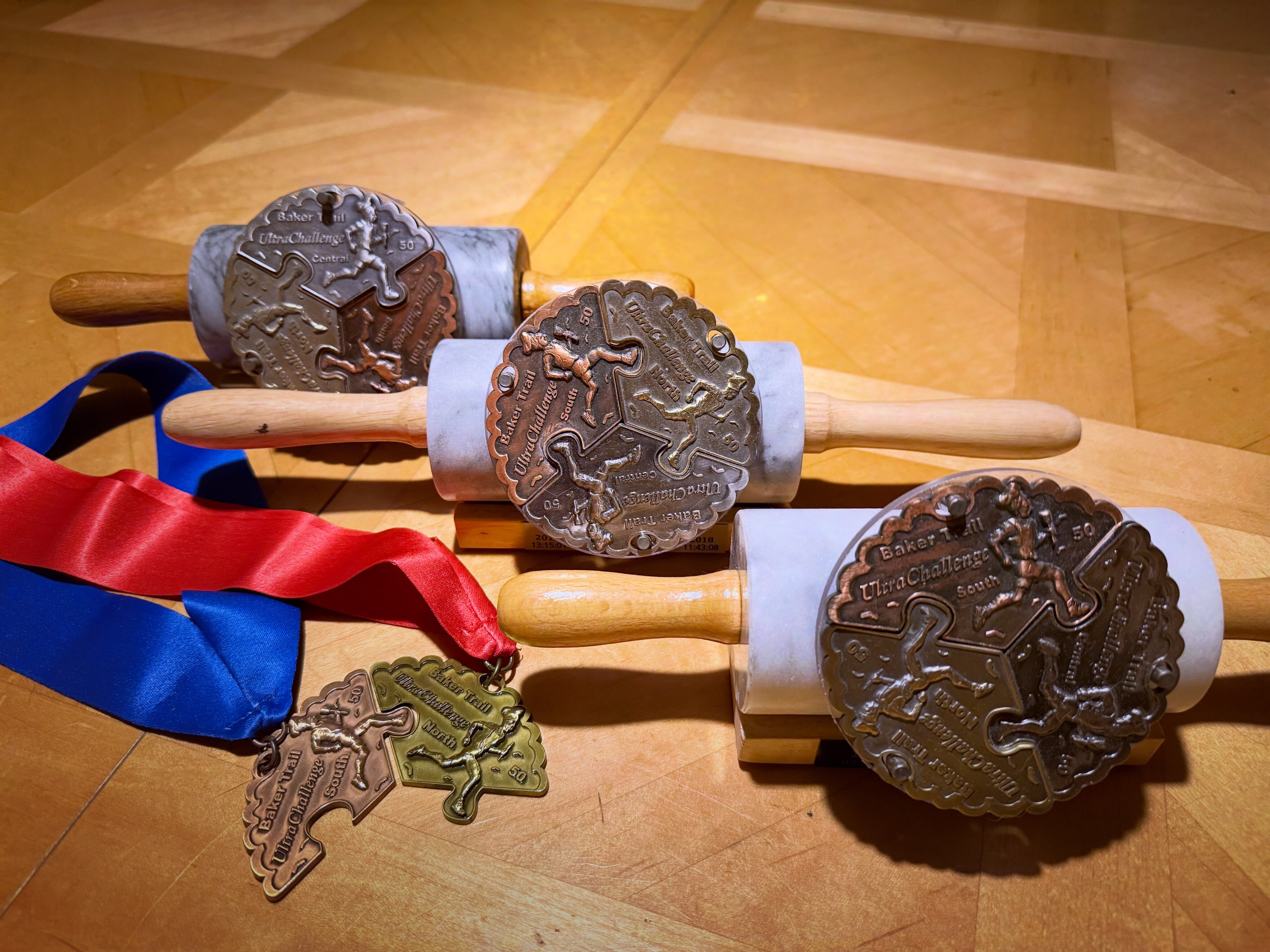
Baker has three sections – North, Central and South – that rotate each year, with a strict 14-hour cutoff. The course cuts through deep woods and along dirt and paved country roads. Finishing a section earns you one piece of a three-part medal, and completing all three earns you a rolling pin that holds the medal pieces, which fit together. I already held the record for the most completions – and the most rolling pins – but I did not finish the North section in 2023, the year my surgeries began. That same northern section came around again, giving me a chance at the second piece toward my fourth rolling pin.
I trained as hard as I could while respecting what my body had been through, and I finished in under 13 hours – close to my best time on that course. All day I felt an immense sense of joy that I was finally doing what I loved again.
Dr. Rodeo and Dr. Demetracopoulos supported me throughout and understood how much running meant to me. Many people told me to give up. My doctors simply helped me heal, so I could get back to the place I wanted to be.
HSS Providers

Schedule a virtual or in-person appointment with an HSS specialist today. Start your request online or call 1.800.796.0482.

Katherine Dydensborg
Morristown, NJ
Ankle Replacement (Ankle Arthroplasty)
Angela Herrygers
Hawley, PA
Ankle Replacement (Ankle Arthroplasty)
Philip Kunhardt
Waccabuc, NY
Ankle Replacement (Ankle Arthroplasty)
Jonathan Bell
Morris Plains, NJ
Ankle Replacement (Ankle Arthroplasty)
Paul Hady
New Egypt, NJ
Ankle Replacement (Ankle Arthroplasty)
Steve D'Gerolamo
Emerson, NJ
Ankle Replacement (Ankle Arthroplasty)
Dorothea Vouyiouklis
New York, NY
Ankle Replacement (Ankle Arthroplasty)
James Pasieka
Calgary, Canada
Ankle Replacement (Ankle Arthroplasty)
Rosemary Damato
Saddle Brook, NJ
Ankle Replacement (Ankle Arthroplasty)
Wayne Sokolosky
Branford, CT
Ankle Replacement (Ankle Arthroplasty)
Henry Ponti
Washingtonville, NY
Ankle Replacement (Ankle Arthroplasty)
Kevin McNeilly
New York, NY
Ankle Replacement (Ankle Arthroplasty)
Chris Husk
Sparta, NJ
Ankle Replacement (Ankle Arthroplasty)
Bob Pattacini
Norwalk, CT
Ankle Replacement (Ankle Arthroplasty)
Wah Chu
Oxford, CT
Ankle Replacement (Ankle Arthroplasty)