
Advice to improve your movement, fitness, and overall health from the #1 in orthopedics in the U.S.
Exercises for Shoulder Impingement
These three moves can help improve shoulder pain in a few weeks.
Advice to improve your movement, fitness, and overall health from the #1 in orthopedics in the U.S.
You may have heard the term shoulder impingement, either because you’ve been diagnosed with it yourself or know someone else who has. “Shoulder impingement is one of the most common diagnoses for shoulder pain,” says Nicholas Hershfield, PT, DPT, an orthopedic clinical specialist at HSS Rehabilitation Brooklyn. “However, it does not always mean that something is being pinched or impinged upon inside the shoulder.”

A more clinically accurate term for this shoulder condition is rotator cuff-related shoulder pain or subacromial pain syndrome to describe similar symptoms. These conditions commonly cause pain around the front or outside of the shoulder, particularly when performing a repetitive overhead task, lifting objects or sleeping on the affected side. As many as two-thirds of people experience subacromial pain in their lifetime, says Hershfield.
Subacromial pain can occur in:
- the rotator cuff (the muscles and tendons surrounding the shoulder joint);
- the biceps tendon (which connects the biceps muscle to the shoulder bone);
- the shoulder labrum (tissue or cartilage around the shoulder socket); or
- the bursa (fluid-filled sacs in the shoulder joint).
Typically, subacromial pain is caused by an overload issue, meaning a stress that the shoulder wasn’t prepared to bear. It could be as simple as picking up a 10-pound weight, feeling a twinge in your shoulder area, and later experiencing a painful pinching sensation in your shoulder when you raise your arm. It can be common in young athletes who overuse their arm by throwing too many pitches or bench pressing heavy weights without building up their rotator cuff and scapular strength first.
If you are experiencing subacromial pain, Hershfield recommends three simple exercises to do at home to strengthen your shoulder:
Prone “I” Exercise
This exercise strengthens the muscles around the shoulder blade that help support the shoulder during reaching, lifting and overhead movement.
- Lie face down on a firm surface with your forehead supported by a folded towel.
- Position your arms alongside your body with your palms facing down and your thumbs pointing forward.
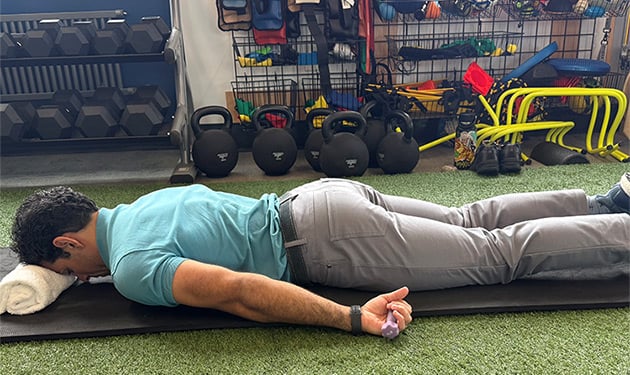
Prone exercise start position - Gently draw your shoulder blades down and slightly toward each other. Avoid shrugging your shoulders toward your ears.
- Keeping your elbows straight, slowly lift both arms a few inches away from the surface.
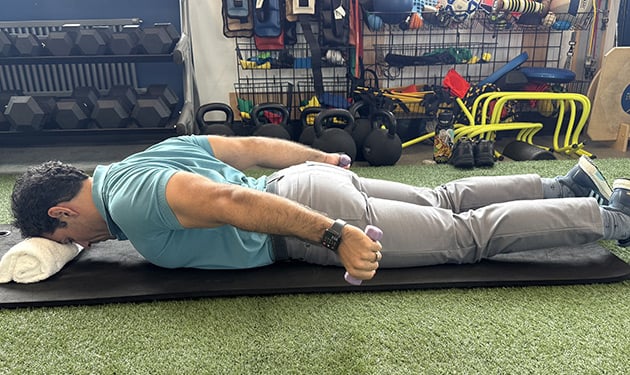
Prone exercise end position - Hold the position for one to two seconds.
- Slowly lower your arms back to the starting position.
- Repeat for three sets of 15 repetitions.
Focus on controlled movement rather than lifting the arms as high as possible. You should feel the muscles working around the back of your shoulders and shoulder blades rather than primarily in your neck or lower back.
Begin without resistance. When you can perform all repetitions with good control and without a meaningful increase in symptoms, you may hold very light weights, such as one-pound weights or small water bottles.
Side-Lying Shoulder External Rotation
Use a rolled-up towel underneath the arm. (The towel ensures you are performing a rotational movement at the shoulder rather than lifting your arm away from your body.)
- Lie on your non-injured side with your head resting on a pillow in a neutral position.
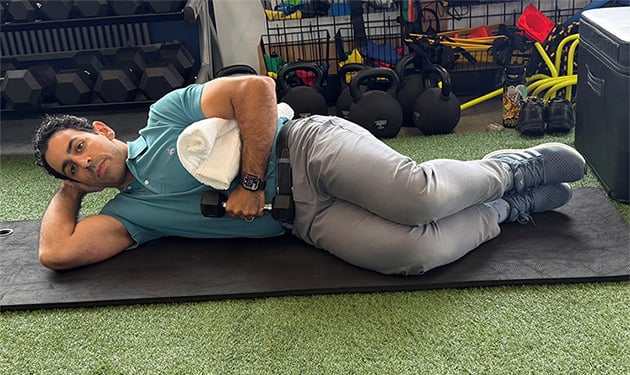
Side-lying shoulder external rotation start position - With your top arm bent at a 90-degree angle in front of you, lift a light weight (Hershfield recommends starting with a one or two-pound weight ) from the surface you’re on straight up it is just above shoulder height. Maintain contact of the arm with the rolled-up towel.
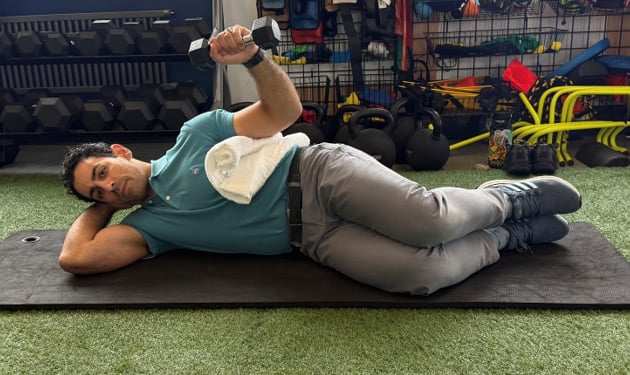
Side-lying shoulder external rotation end position - Lower it slowly back down.
- Repeat the lift for three sets of 15 or, if your body can tolerate it, go straight through to 30 for two sets. Eventually, you can increase the weight up to five pounds
Shoulder Scaption Exercise
- In a standing position, hold light weights in each hand by your side.
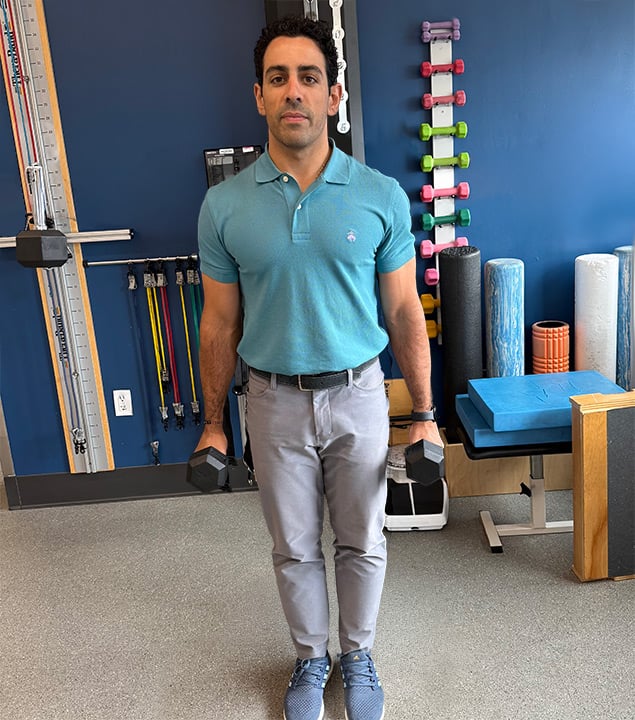
Shoulder scaption exercise start position - Slowly lift your arms straight up in the air until they are at shoulder height. Your arms should form a “V” shape.
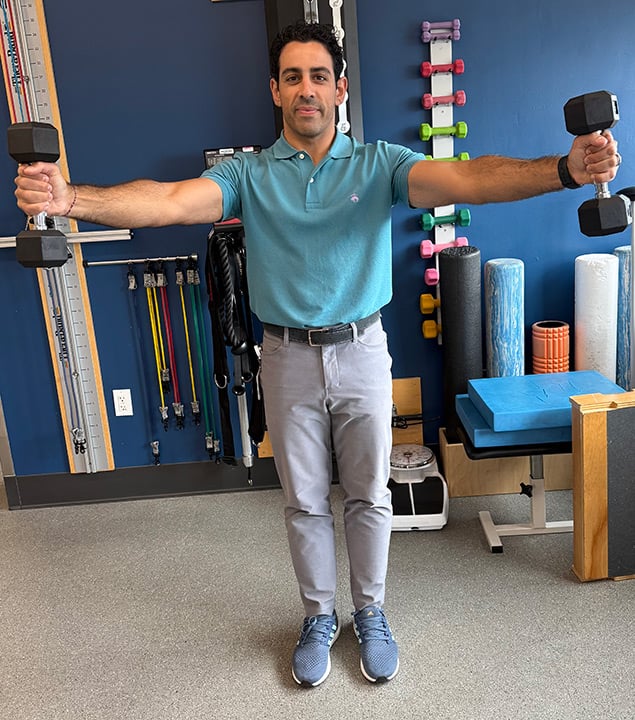
Shoulder scaption exercise end position - Slowly lower the arm back down to your side.
- Repeat the lift for three sets of 15, pausing between sets if needed to decrease shoulder burn, or go straight through to 30. Gradually, you can increase the weight up to 10 pounds.
When to See a Specialist for Shoulder Pain
If you repeat these exercises 3 to 4 times weekly, you should expect to feel an improvement in ability to tolerate loading of the shoulder and reduction in pain within about three weeks, Hershfield says. If you’ve gone six weeks without results, or the pain is worsening without response to reduction of provocative activities, it’s time to seek treatment from a physical therapist or orthopedist. These specialists can provide hands-on, individualized care.
Hershfield advises seeking medical care immediately if you experience shoulder pain in combination with any of the following:
- It began after a fall, collision or other significant trauma.
- It is accompanied by a sudden inability to raise the arm.
- It occurs with fever, redness, substantial swelling or unexplained illness.
- It is associated with progressive numbness, tingling or weakness in the arm or hand.
- It occurs with chest pressure, shortness of breath, sweating, nausea or dizziness.
Published 8/24/2026
About the Expert

Nicholas Hershfield is a physical therapist with HSS Rehabilitation.